A regulatory consultation is an invitation to comment on a proposal. It is not, by itself, a final rule.
Insurance reforms often pass through several distinct stages, and the labels matter. Binding requirements generally change only when the relevant legal or supervisory step has been completed, although firms may begin assessment and preparation earlier.
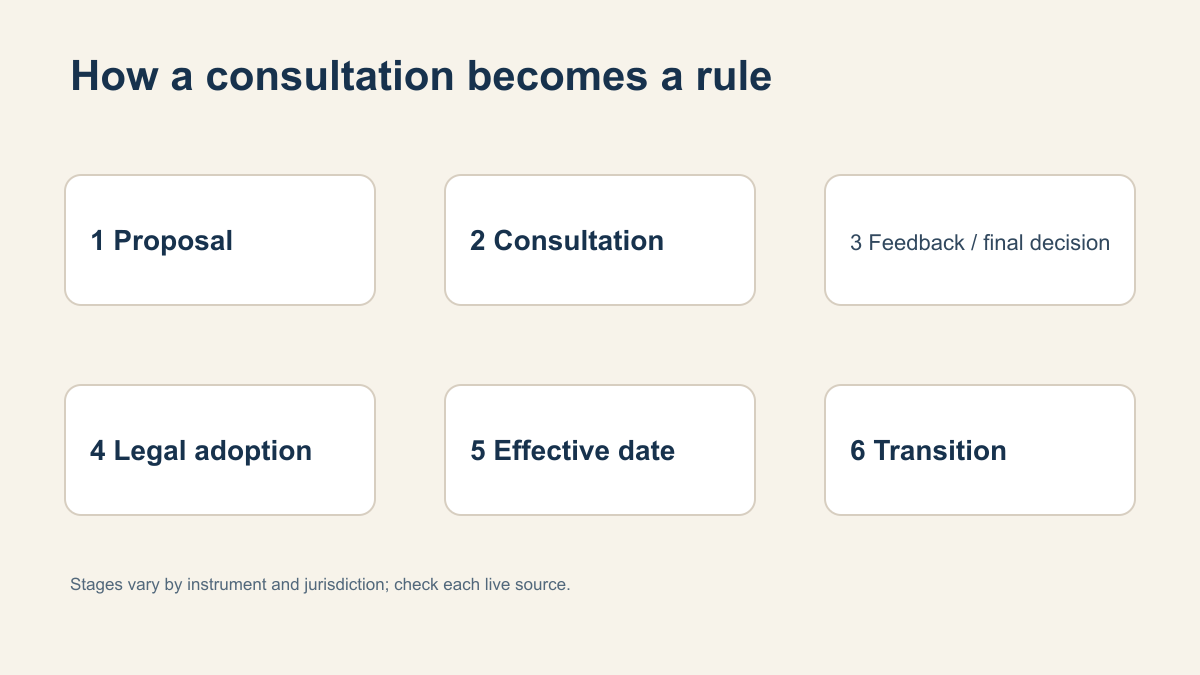
The live examples below were checked in August 2026. Their procedural stages may change, but the six-part method remains useful: proposal, consultation, feedback or final decision, legal adoption, effective date and transition.
1. Proposal
A regulator or public authority publishes draft policy, rules, standards or technical advice. The document should identify its scope, evidence, proposed text and intended timing. At this point, the content can still change.
EIOPA’s July 2026 review of insurance disclosures under the Taxonomy Disclosures Delegated Act is at this stage. It contains proposed KPI and template changes, not adopted reporting requirements.
2. Consultation period
Stakeholders submit responses by a stated deadline. The deadline may include a time and timezone, which should be recorded precisely. A consultation can be open, closed or extended; an old article should not call it open without checking the live source.
3. Feedback and final decision
The authority considers responses and may publish a feedback statement, final policy or final standards. The final package may differ materially from the proposal.
APRA’s targeted changes to Australia’s general-insurance and reinsurance framework illustrate this stage: the consultation is closed and the regulator published its final response in July 2026.
4. Legal adoption
Some decisions require another institution, legislation or a delegated legal act before they become binding. A supervisor’s technical advice may therefore be final as advice while the law itself remains unchanged. The adoption route depends on the jurisdiction and instrument.
5. Effective date and transition
Publication and legal adoption do not always mean immediate application. A final instrument may specify a future effective date and interim testing, reporting or parallel-run arrangements. APRA’s final standards, for example, are scheduled to take effect on 1 January 2027.
The PRA’s friendly-society consultation shows a different pattern: responses are due in October 2026, a policy statement is expected before April 2027, and the proposed changes would take effect when that statement is published.
Reading regulatory status
For any reform, record six things separately: what is proposed, the response deadline, whether feedback or a final decision exists, what legal adoption is required, the effective date, and any transition period. If one field is unknown, say so rather than treating the nearest date as the answer.
Sources and methodology
Status checked in August 2026 against the cited EIOPA, PRA and APRA pages. The examples illustrate process stages; they do not imply that every jurisdiction follows the same legal sequence. When an example changes status, apply the same six-part method to the updated source record.